
In 521 BC Darius I had his account of how he took the Persian throne cut into a limestone cliff sixty metres above the road, in three languages, across a panel fifteen metres high and twenty-five wide. Two and a half thousand years later a British officer hung off that cliff copying it, and the copy was what allowed scholars to read cuneiform at all — every Assyrian and Babylonian text we can read today was unlocked from this rock face.
Bisotun is thirty kilometres from Kermanshah and almost nobody goes. That is the subject of this page: a province with an Achaemenid Rosetta Stone, the finest Sasanian reliefs in Iran, and a visitor count that does not reflect either.
Before you plan anything: this is a destination guide, written to be useful whenever you are able to use it. Whether to travel to Iran at present is a separate question with a different answer — see our current situation report, reviewed 12 September 2026.
What the Cliff Actually Says
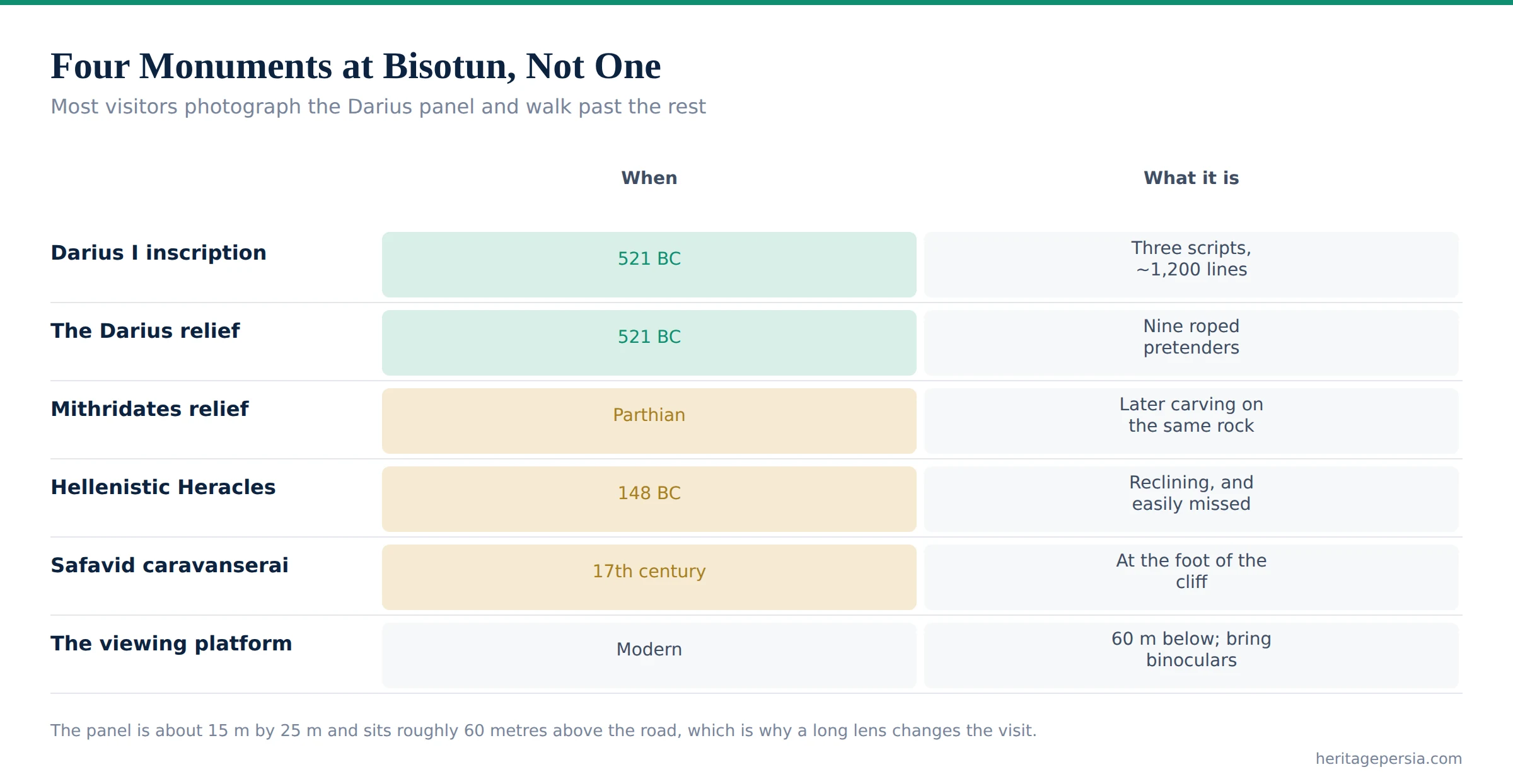
The Bisotun relief shows Darius with his bow, one foot on a prone figure — Gaumata, the rival he claims was an impostor — and nine defeated pretenders roped together in front of him. Above them the winged figure of Ahura Mazda. It is a coronation poster carved into a mountain.
The text beneath and around it runs to about 1,200 lines in three cuneiform scripts: Old Persian, Elamite and Babylonian. It is the only monumental Achaemenid text that records a specific historical event rather than a formula, which makes it the closest thing to a first-person political document the empire left.
And because the same content appears in three languages, one of which scholars could partially read, it did for cuneiform what the Rosetta Stone did for hieroglyphs. That is not a tourist-board comparison; it is what happened, and it is the reason this cliff matters to people who have never been to Iran.
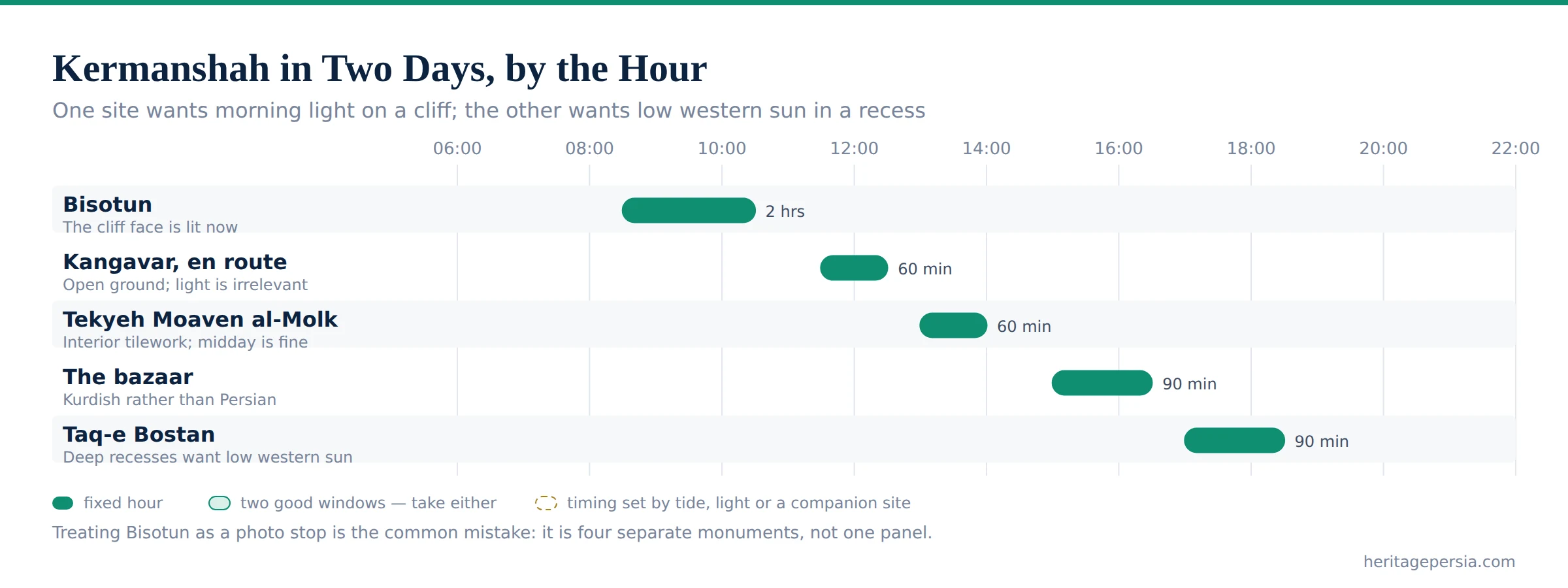
The practical point is that it is sixty metres up. You see it from a viewing platform and the detail needs binoculars or a long lens — and a guide who can tell you which figure is which, because the site’s own signage is thin. Go in the morning, when the cliff face is lit.
Every Site, With the Hour to Go
| Site | What it is | Time | From the city | Best hour |
|---|---|---|---|---|
| Bisotun UNESCO 2006 | Darius I’s trilingual inscription and relief, 521 BC, 60 m up a cliff | 2 hrs | 30 km · 30 min | Morning, when the face is lit |
| Taq-e Bostan | Sasanian rock reliefs in two carved arches, 4th century AD onwards | 90 min | 5 km | Late afternoon; the recesses are deep and want low light |
| The Anahita temple, Kangavar | Massive stone platform and columns, long attributed to the water goddess | 60 min | 87 km · 1 hr | Any; it is open ground. Combines with the drive to Hamadan |
| Tekyeh Moaven al-Molk | Qajar mourning hall tiled with scenes from Karbala and from Persepolis | 60 min | In town | Midday; it is interior and the tilework is the point |
| The bazaar | A working provincial market, Kurdish rather than Persian in feel | 90 min | In town | Late morning or after five |
| Bisotun’s other carvings | The Parthian Mithridates relief, a Hellenistic Heracles of 148 BC, and a Safavid caravanserai | Within the 2 hrs | Same site | Same visit; most visitors miss all three |
Two days covers the table comfortably. The common mistake is treating Bisotun as a photo stop on the road — it is a large site with four separate monuments and the Darius panel is only the famous one.
Taq-e Bostan, Which Deserves Its Own Visit
Five kilometres from the middle of Kermanshah, two arches are cut into the rock beside a spring-fed pool, and they contain the best-preserved Sasanian sculpture in the country.
The smaller arch — about six metres by five — carries Shapur II and Shapur III facing each other with Pahlavi inscriptions naming them. The larger one shows the investiture of Khosrow II, flanked on its side walls by two hunting scenes: a boar hunt in the reeds and a deer hunt, both crowded with boats, elephants and musicians. They are the closest thing to a Sasanian narrative painting that survives, cut in stone.
Go in the late afternoon. The arches face roughly east and are deeply recessed, so the middle of the day leaves them flat and dark while low western light reaches in. It is now an archaeological park with a pool in front, which is pleasant and means the site is busy with local families in the evening rather than with tourists.
A Kurdish Province
Kermanshah is majority Kurdish and this is not a footnote — it changes the food, the language on the street, the music and the welcome.
Kurdish is what you will hear, with Persian as the shared second language. Nobody will expect you to have any Kurdish, and the two or three words you do learn will land harder here than Persian does elsewhere. Our phrasebook covers Persian; for Kurdish, ask your guide on the first morning.
The food diverges properly from the plateau. Khoresh-e khalal, a lamb stew with slivered almonds and barberries, is the dish the city is known for, and the local nān-e berenji rice cookies are the souvenir. Our food guide maps the country; this is one of the regions where it stops applying.
When to Come
April to June and September to October. The city sits at about 1,400 metres and the province runs up into the Zagros behind it, so spring is green and late, and autumn is clear.
Winter is genuinely cold with snow on the passes, and while the sites stay open, Bisotun in a February wind is an endurance test rather than a visit. High summer runs into the high thirties — workable on the summer schedule of early mornings and late afternoons, and not otherwise.
How It Fits a Trip
As a western loop with Hamadan. The natural shape: Tehran to Hamadan, Hamadan to Kermanshah via Kangavar, and back. Four to five days, and it is the best use of this province.
On the way to or from Khuzestan. Kermanshah sits north of Khuzestan and the two combine into a western archaeological week that takes in five UNESCO inscriptions and almost no other visitors.
Not as a day trip from anywhere. Kermanshah is about 525 kilometres from Tehran and there is no version of this that works in a day.
Not inside a ten-day classic route. Adding it costs you Kashan or Yazd, which is the wrong trade on a first visit. Our fourteen-day guide covers where a region like this does fit.
Practical Notes
Getting there. Domestic flights from Tehran take about an hour; the road is around 525 kilometres and a long day. There is no useful train.
Accommodation is provincial. Business hotels rather than courtyard houses — there is no tradition of the kind that makes Kashan and Yazd a pleasure. Our accommodation guide sets out what each category actually gives you.
A guide matters more here than on the classic route, because the signage at Bisotun is thin and the reliefs need someone to read them aloud.
Bring binoculars. This is the one Iranian site where they change the visit rather than improving it.
Cash, as everywhere. No foreign card works in Iran — see the money guide.
✉️ Interested in the west? Tell us how many days you have and we will say whether Kermanshah works alone or wants Hamadan and Khuzestan with it. Talk to our team →
Continue reading
Frequently Asked Questions
What travellers ask our guides, answered on the ground.
A Western Route
Tell us how many days you have and we will say whether Kermanshah works alone or wants Hamadan and Khuzestan with it.
See Western Routes →