
Hamadan is Ecbatana, the Median capital — the first capital in Iranian history, and the summer seat of every empire that followed it through to the Sasanians. UNESCO inscribed the mound in 2024, which makes it the most recent Iranian site on the list and one almost no itinerary has caught up with.
It is also the honest truth that what survives is a ruin field rather than a monument. This page is about what is actually there, why it is worth the detour anyway, and the four other things in the province that most visitors come for instead.
Before you plan anything: this is a destination guide, written to be useful whenever you are able to use it. Whether to travel to Iran at present is a separate question with a different answer — see our current situation report, reviewed 12 September 2026.
What Is Actually on the Mound
Tepe Hegmataneh sits in the middle of the modern city — a seventy-five-hectare mound with a buffer zone of nearly three hundred hectares around it, which is why Hamadan’s centre has a hole in it shaped like an archaeological site.
What you see is a grid. Excavation from 1983 onwards uncovered a planned Parthian-period quarter of mud-brick houses laid out on intersecting streets, along with stretches of Median defensive wall, the remains of a fire temple, and Achaemenid column bases. The first dig, by Charles Fossey in 1913, turned up glazed brick and inscribed column fragments.
We will say the uncomfortable thing plainly: if you arrive expecting Persepolis you will be disappointed within ten minutes. There are no standing buildings and no columns in the air. What is here is a city plan at ground level, the oldest layers of Iranian urban history, and a small museum holding what came out of it.
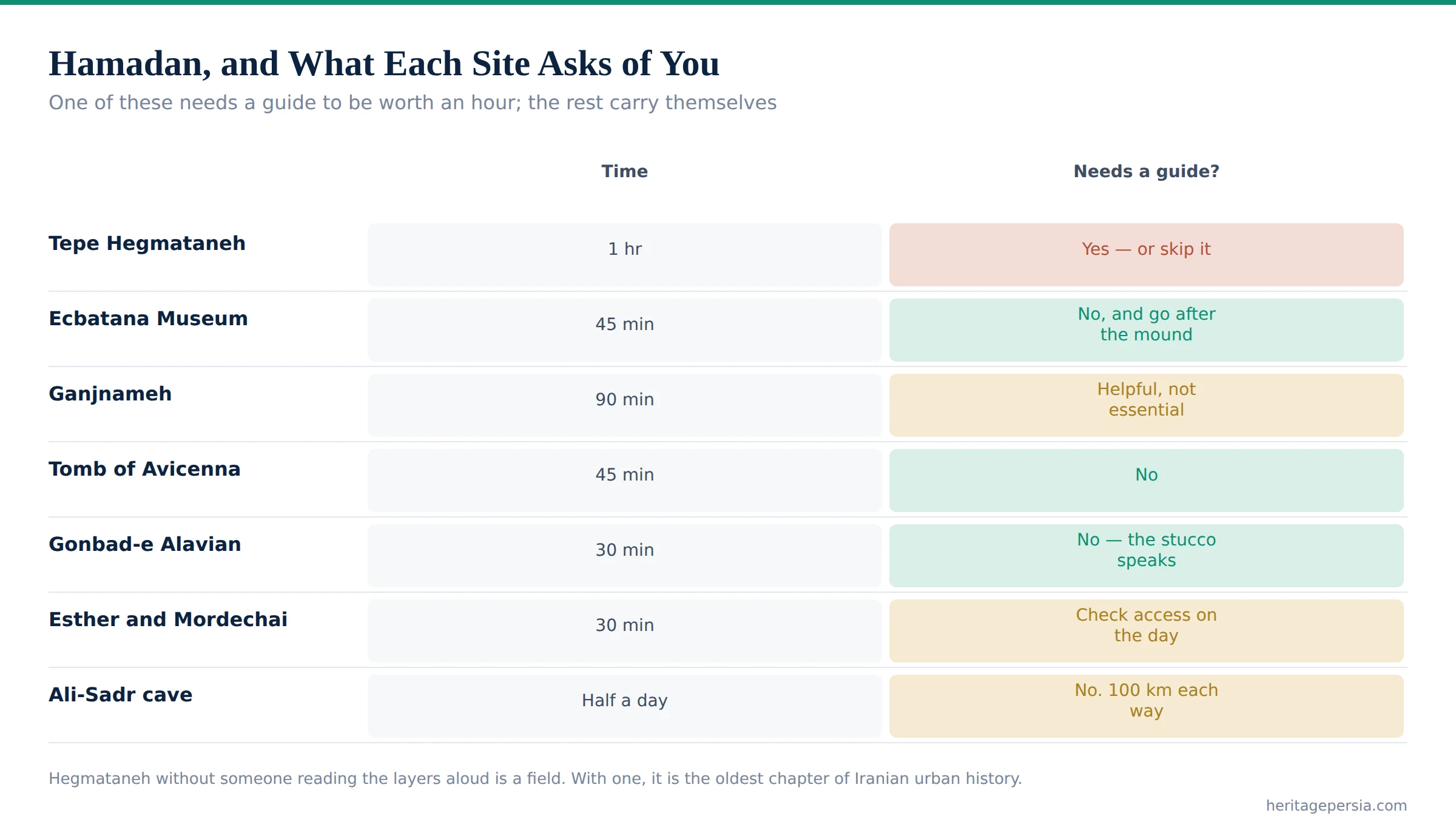
What makes it worth an hour is context rather than spectacle. Ecbatana is where Iranian statehood starts, and standing on the mound with someone who can point out which wall is Median and which street is Parthian is the only way that becomes real. Go with a guide or do not bother.
Every Site, With the Hour to Go
| Site | What it is | Time | From the centre | Best hour |
|---|---|---|---|---|
| Tepe Hegmataneh UNESCO 2024 | Ancient Ecbatana: Median walls, a Parthian street grid, Achaemenid column bases | 1 hr | In the city | Morning, with a guide. It is exposed ground |
| Ecbatana Museum | What came out of the mound, in 600 square metres | 45 min | At the site | Straight after the mound, not before |
| Ganjnameh | Two Achaemenid inscriptions of Darius and Xerxes, cut into granite at 2,000 m | 90 min | 12 km · 25 min | Morning. There is a waterfall and it is a local picnic spot by afternoon |
| Tomb of Avicenna Ibn Sina | A 1950s tower over the grave of the physician whose canon taught European medicine for five centuries | 45 min | In the city | Any. There is a small museum and a library |
| Gonbad-e Alavian | A 12th-century Seljuk tomb tower with some of the finest stucco in Iran | 30 min | In the city | Midday; it is interior work |
| Tomb of Esther and Mordechai | A shrine held by tradition to hold the biblical pair, and a centre of Iranian Jewish pilgrimage | 30 min | In the city | Check access on the day |
| Baba Taher’s tomb | The 11th-century poet of the Hamadan dialect, in a modern pavilion | 20 min | In the city | Late afternoon, with the park |
| Ali-Sadr cave | An 11-kilometre water cave visited by boat, at a constant 12 °C | Half a day | 100 km · 1.5 hrs | Any. It is underground and the weather outside is irrelevant |
The city sites are a single day on foot and by taxi. Ali-Sadr is the thing that turns Hamadan from one day into two, and it is a decision about what kind of traveller you are rather than about the schedule.
Ganjnameh, and Why It Is There
Twelve kilometres south-west of the city, on the flank of Mount Alvand at about two thousand metres, two panels are cut into granite above a creek. Each is two metres by three, twenty lines, in the same three cuneiform languages as Bisotun.
The left one is Darius the Great, the right one his son Xerxes, and apart from the royal name the two texts are nearly identical: praise of Ahura Mazda, the king’s lineage, his titles. No history, no event — these are formal declarations rather than the narrative Darius cut at Bisotun.
The interesting question is why here. This was the main pass through Alvand on the east-west road, and Ecbatana below it was the Achaemenid summer capital precisely because of the altitude and the climate. The inscriptions sit where every traveller on that road would pass them, which is the point of them.
The local name means treasure book, from a belief that the undeciphered text was the code to a hidden hoard. Nobody could read them for two thousand years; what unlocked them was the cliff at Bisotun, ninety minutes west.
When to Come, and the Altitude
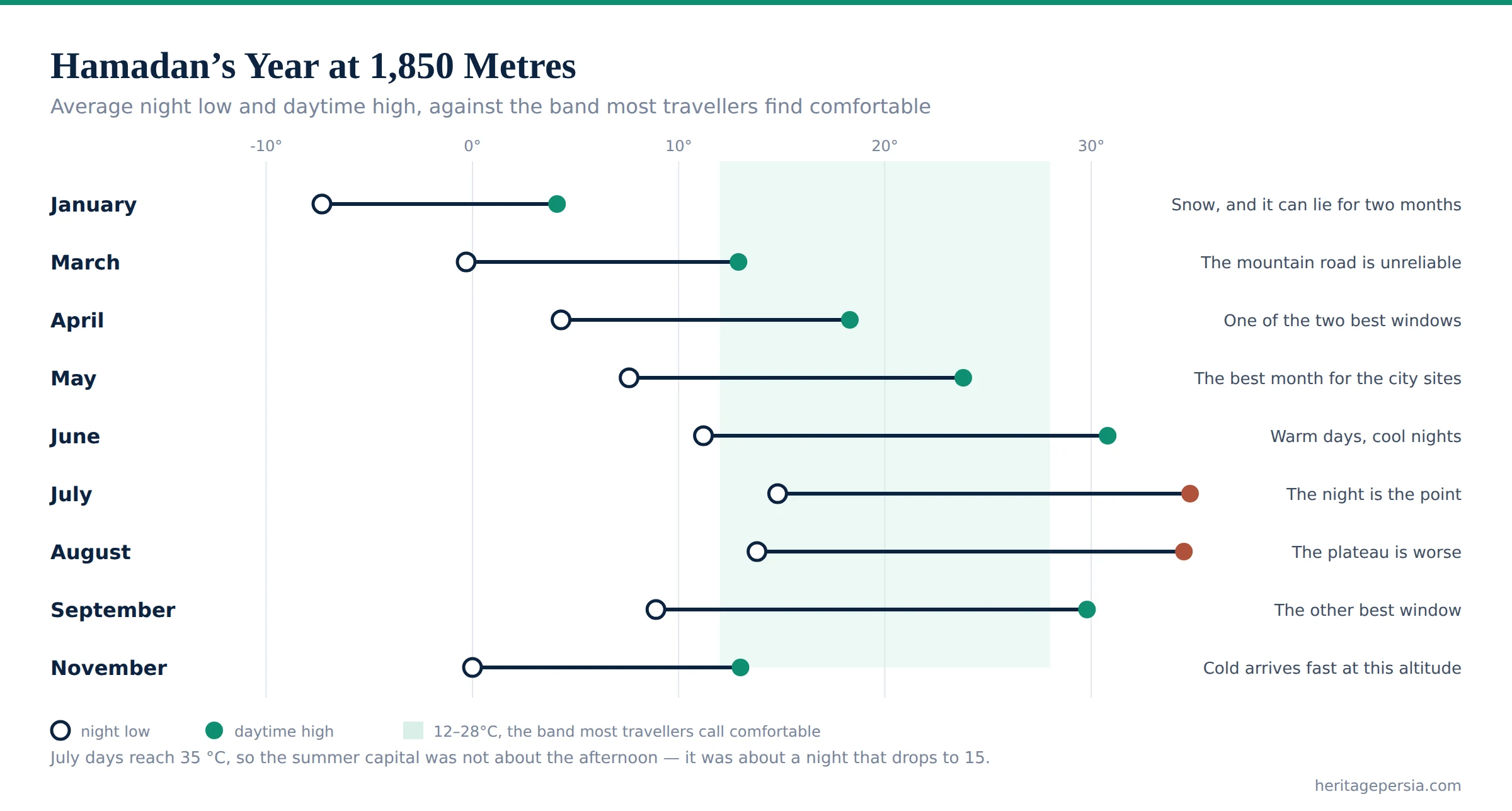
At 1,850 metres Hamadan is one of the highest provincial capitals in Iran and it behaves accordingly.
Summer works, and the reason is the night. July days here average about thirty-five degrees, only a few below Isfahan. What changes is after dark: the average July low is under fifteen, so the heat lets go completely every evening in a way it does not on the plateau. That is what made this the Achaemenid summer capital, and why Hamadan belongs on a summer itinerary.
Winter is serious. Heavy snow is normal and can lie for two months; the record low is −34 °C. Ganjnameh and the mountain road are affected, the city sites are not.
Spring and autumn are short and good, with May and late September the two best windows.
How It Fits a Trip
With Kermanshah, as a western loop. The obvious shape and the right one: Tehran to Hamadan by road in about five hours, then ninety minutes on to Kermanshah via the Anahita temple at Kangavar. Four to five days for the pair.
On the road west from Tehran. Hamadan is 360 kilometres from the capital and the natural first stop on any route into the Zagros or on toward Tabriz.
As a UNESCO completist stop. If you are working through the list, Hegmataneh is the newest entry and pairs with Bisotun in a single western trip.
Not on a first visit of ten days. Hamadan earns its place on a second trip or a long first one, and our 21-day guide is where a region like this belongs.
Practical Notes
Getting there. About 360 kilometres from Tehran, five hours by road, with limited flights. Most people drive, and the road is good.
Take a guide for the mound and skip one for the rest. Hegmataneh without interpretation is a field; the museum, the tombs and Ganjnameh carry themselves.
Ali-Sadr is a half day and a commitment. A hundred kilometres each way for a boat ride through a cave — excellent with children, a long detour without them.
Accommodation is provincial business hotels, as in Kermanshah. Our accommodation guide sets out the categories.
Pack a layer whatever the month. At 1,850 metres the evenings drop hard even in July.
✉️ Building a western route? Tell us your days and we will say whether Hamadan works alone, with Kermanshah, or as the first night on a longer road west. Talk to our team →
Continue reading
Frequently Asked Questions
What travellers ask our guides, answered on the ground.
A Western Route
Tell us your days and we will say whether Hamadan works alone, with Kermanshah, or as the first night on a longer road west.
See Western Routes →